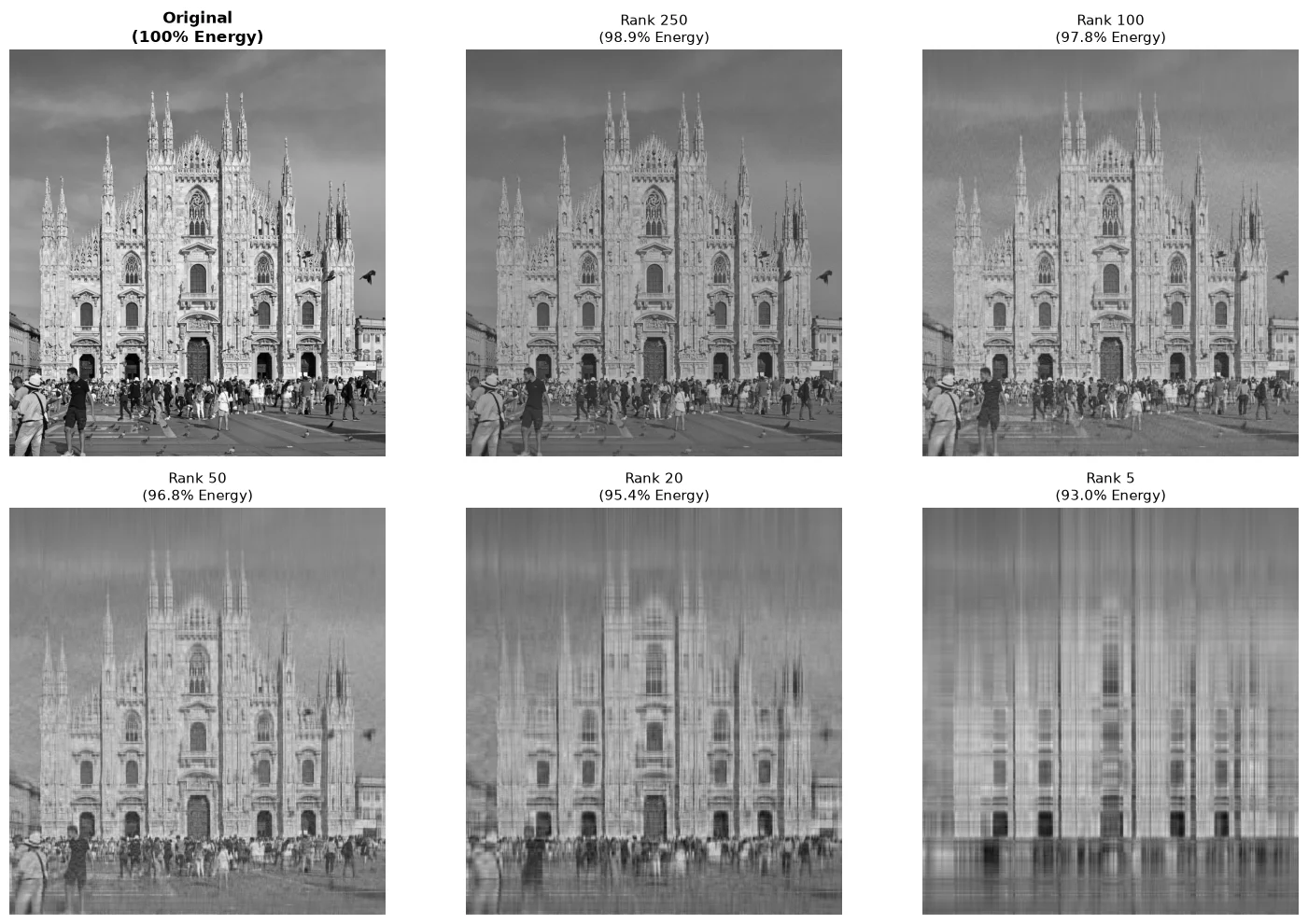
Singular Value Decomposition (SVD) is a fundamental algorithm in numerical linear algebra. In this post, I will show how to factorize a matrix and use low-rank approximation to compress a high-resolution image, using Python.
The Mathematics of SVD Every real matrix $A$ of dimensions $m \times n$ can be factored into three matrix:
$$A = U \Sigma V^T$$
Where:
$U$ is an $m \times m$ orthogonal matrix of left singular vectors. $\Sigma$ is an $m \times n$ diagonal matrix containing the singular values ($\sigma_i$) in descending order. $V^T$ is an $n \times n$ orthogonal matrix of right singular vectors. By keeping only the largest $k$ singular values (where $k < \text{rank}(A)$), we can form a truncated approximation $A_k$ that captures the maximum possible “energy” (or variance) of original matrix:
...